
01Connect
Before the timer starts, decide what this block is actually for. One clear outcome. One thing you are not doing. A reason to stop wandering before you even begin.
Free guide
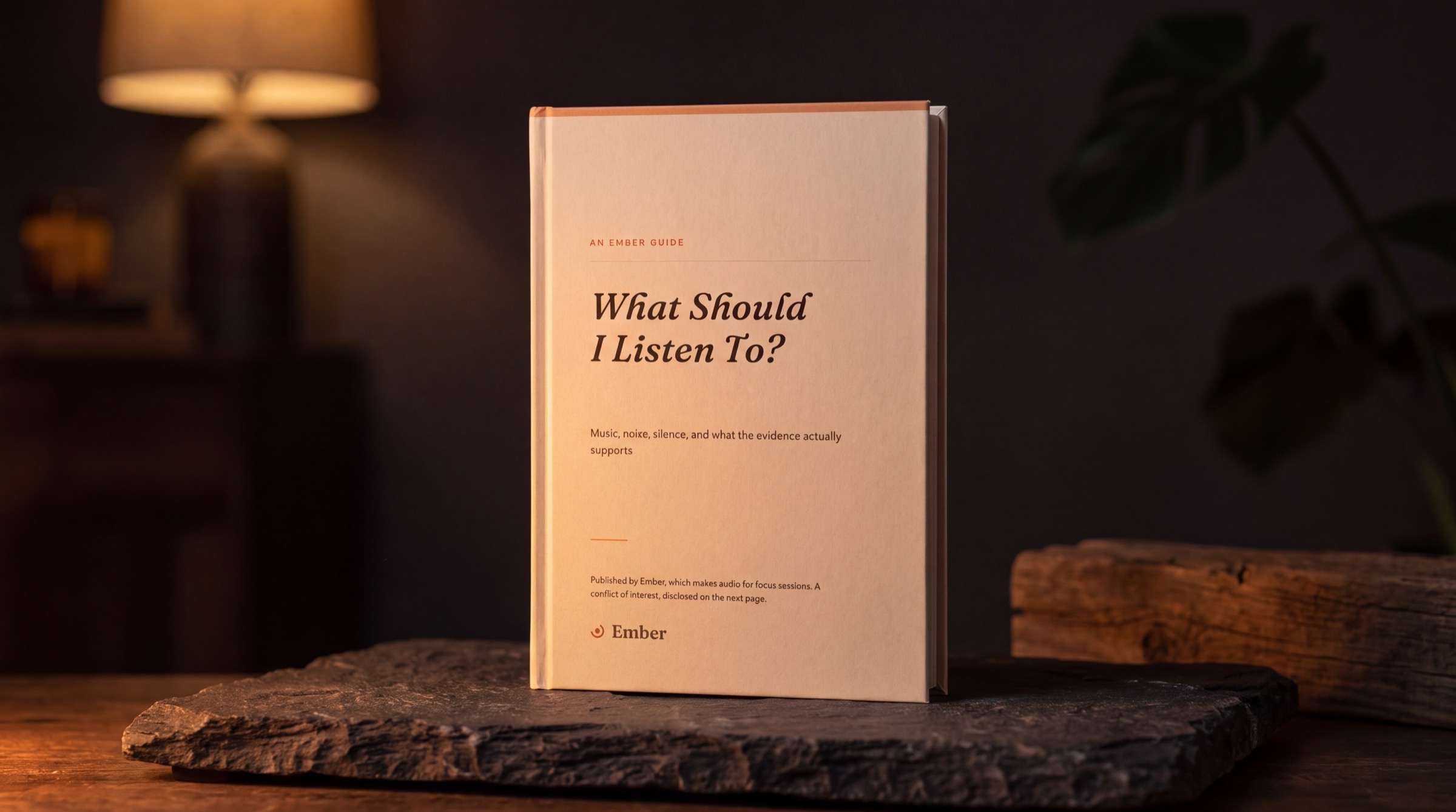
Lo-fi. Rain. Brown noise. Binaural beats. Silence. There is a lot of confident advice online, and the research is much less dramatic.
Every claim in the guide is graded, from strong down to folklore, so you can see what is solid, what is promising, and what mostly survives because the internet keeps repeating it.
Your download should start automatically. If it does not, open the guide here.
Read page three first. It answers the question on its own.
Written by me, and I make audio for focus sessions. That is a conflict of interest, and the guide says so on its first page. Several of its conclusions are not flattering to products like mine.

A deep-work ritual, not just music
Focus deeply. Recover properly. Come back tomorrow.
Ember helps you decide what this session is for, protect one block of focus, take a break that actually helps you reset, and leave yourself a clear way back in.
Free. No account. Nothing to install. What you write stays in your browser.
You start in the morning. The work is moving, so you keep going. Lunch becomes “in a minute.” The break becomes your phone. By late afternoon you are technically still at your desk, but your brain left a while ago.
And tomorrow? Starting again feels harder than it should.
That is the part I kept noticing. Most focus tools are very good at helping me start a block. I wanted something that also helped me leave the block well enough to come back.
A good focus session should help you do the work today without borrowing all of tomorrow’s energy.
A complete ritual
Four steps, one repeatable way to work. You can run Ember in thirty minutes or build a longer session. The point is not the exact number. The point is the order.
01Connect
Before the timer starts, decide what this block is actually for. One clear outcome. One thing you are not doing. A reason to stop wandering before you even begin.

02Focus
One task. One screen. One finish line. Ember gives you the timer and the sound, then gets out of the way so you can work.

03Recover
This is the part I could never find in a normal timer. Your break is guided, not abandoned. Breathe. Move. Look away from the screen. Doodle something terrible for two minutes.

04Return
Before you leave, write down what moved, what is still open, and where you want to start next time. You are not leaving tomorrow-you a mystery.
Guided recovery
If the timer rings and you immediately open Instagram, Slack, the news, or six messages, you stopped working. But your brain did not necessarily get less input.
The research on micro-breaks is more modest than most productivity advice makes it sound. Short breaks reliably help people feel a little less fatigued and a little more energized. They do not reliably improve every kind of performance. I like that answer because it is useful without pretending to be magic.
Breathe
Calm your mind.
Move
Release tension.
Reset
Give your eyes a real break.
Doodle
Let your mind wander differently.
A 2022 meta-analysis combined 22 independent samples and 2,335 participants. Micro-breaks showed small positive effects on vigour and fatigue, while the overall performance effect was not statistically significant. Albulescu et al. (2022), PLOS ONE. Not significant means no effect was detected at this sample size, not that there is none.
What actually helps deep focus
Here is the simpler version of what holds up.
A vague intention like “I need to work on the app” leaves a lot of decisions for later. A specific plan removes some of them. Research on implementation intentions has repeatedly found that deciding in advance when, where, and how you will act can make follow-through more likely.
That is why Ember asks for a clear target before the timer begins.
Gollwitzer & Sheeran (2006), Advances in Experimental Social Psychology.
That two-minute “quick check” can cost more than two minutes. Research on attention residue suggests that when we switch away from unfinished work, part of our attention can stay stuck on what we just left.
So Ember is deliberately boring during Focus. One target. Very little else to touch.
Leroy (2009), Organizational Behavior and Human Decision Processes.
Music can make a session feel better. It can cover distracting noise. It can become part of a familiar routine. But the research does not support the idea that background music automatically makes cognitive work better.
The clearest practical rule is much less exciting: when the work itself uses words, lyrics are more likely to get in the way.
Kämpfe, Sedlmeier & Renkewitz (2011), Psychology of Music.
Built for real life
I do not think founders need a magic “founder frequency,” or that students need a different brainwave. The idea is simpler: a ritual is easier to come back to when it feels familiar. So Ember changes the language, pacing, and atmosphere a little depending on what kind of work you are sitting down to do.

Your own project. Your own deadline. Nobody is standing over you telling you what matters today. Ember helps you name the thing you are actually building before the busywork takes over.

A deliverable. A report. The task you need to finish before the inbox steals the rest of the afternoon. The ritual is shorter and gets to the point quickly.

A chapter. An exam. A paper. A block that needs enough structure to keep you from reading the same paragraph six times while thinking about something else.

Coming with the iPhone app
Doing hard work alone can get very quiet. Quests are twenty-one-day focus groups built around showing up for your own goal alongside people who are doing the same thing for theirs.
Not a leaderboard. Not a streak you panic about losing. Just a small sense that you are working on your thing, other people are working on theirs, and everybody came back today.
It is being built now. There are no member counts or success numbers yet, because I would rather show you real numbers later than decorative ones now.
Articles

Music can make work feel easier without necessarily making the work better. What the research says about lyrics, instrumental music, binaural beats and engineered audio, and the one rule I would use.
Read article →

The timer is only the middle. A repeatable focus session starts before you press play and ends by making the next session easier to begin.
Read article →
Six questions
Why is it so hard to begin?
1 article
Why does one quick check cost so much?
0 articles
Why didn’t that break help?
0 articles
Does focus music actually work?
1 article
How do you sit down and actually study?
0 articles
What is this block even for?
0 articles
Frequently asked questions
Here are the ones people ask first.
A deep-work ritual in your browser. You set the intention, focus on one thing, take a guided recovery break, and leave yourself a clear way back into the work.
Not really. You can use Pomodoro-style timing if you like, but Ember is built around the whole ritual, not one fixed 25/5 interval. You choose the shape of the session, and Ember guides the break instead of simply counting it down.
Most focus tools solve one piece of the problem: music, a timer, blocking distractions, or a streak. Ember connects the pieces into one repeatable ritual: Connect, Focus, Recover, Return.
No. You can run the ritual without creating an account.
Yes. You can run a complete session for free, with no card and no account.
You choose the kind of reset you want and Ember guides it. That can be breathing, movement, visual rest, or a short creative reset. The point is to reduce input, not replace work with another feed.
Instrumental sound with no lyrics. For sessions where you need to listen to something else, Ember can use rain or steady sound that stays out of the speech range. The audio supports the environment. Ember does not claim the music itself makes you focus.
Yes. You can choose the block length, break length, and number of cycles.
Twenty-one-day focus groups where you work on your own goal alongside people showing up for theirs. Quests are being built for the iPhone app.
The iPhone app is in development. The web app works on mobile in the meantime.

Ready to go deeper?
Ember is new, and I am building it in public. There is no logo wall here and no “10,000 people transformed” number, because we are not there yet. What I can show you is the work.
No account. No card. Just bring the work you already need to do today.